
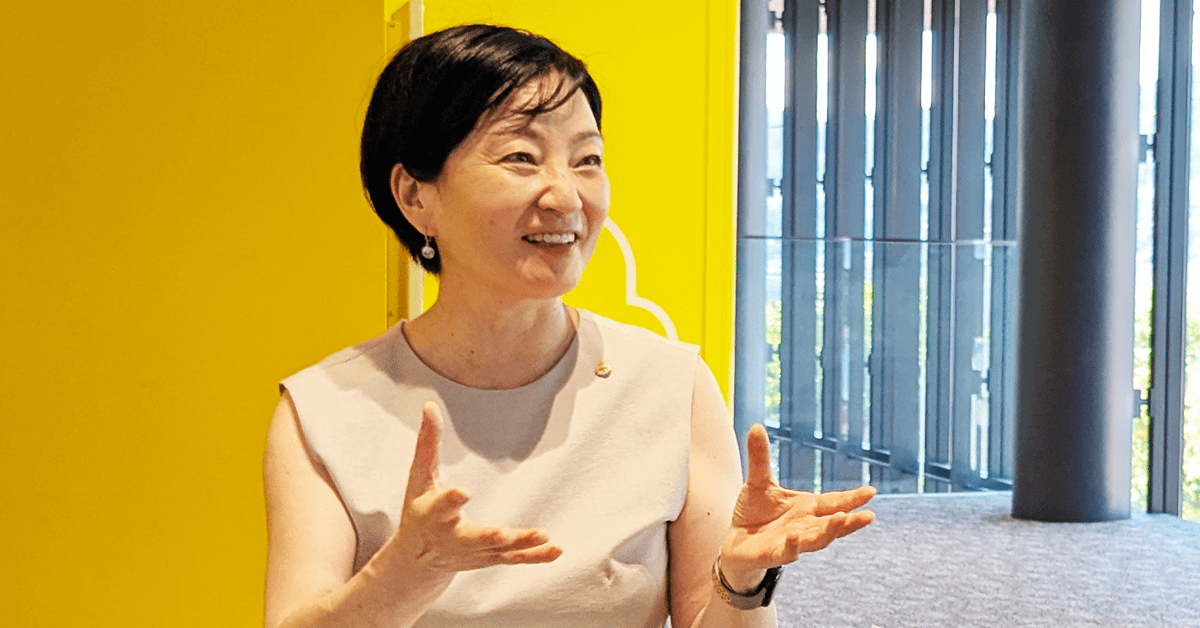
Parents and children enjoy watching sports together. Sometimes, experiences that parents choose thinking their children will enjoy can be a burden on a child’s developing brain. Professor Masami Nanakida of the Department of Early Childhood Education at Hijiyama Junior College is tackling this issue. She is developing OmimimO earmuffs to protect children’s hearing and is working to spread this new habit throughout society. Today, I will ask about the origins of the project and its background.

🎧What is the OmimimO project?
The story of a small earmuff born from a passion for soccer and insights gained during the pandemic.
S (Starlite): As a mother of a child, I am concerned about loud noises making children feel exhausted.
You proposed OmimimO as a solution to that issue. What was your motivation for starting this product?
N (Professor Nanakida): OmimimO is less a product and more a message to society.
It is a project embodying the call to “Let’s pay more attention to children’s development and respect the dignity of each individual!”. I would like to create a culture where society watches over children.
S: Please tell me what led you to that thought.
N: I have two major reasons.
One of them is my love for soccer. I love the Sanfrecce Hiroshima team.
J.League has the slogan of making Japan a happier country through sports, and Sanfrecce Hiroshima’s home stadium truly embodies this idea. A love for making people happy radiates throughout the stadium and the management’s initiatives. That is why families of all ages come to watch the games.
The presence of many preschool-aged children is also one of the charms of stadiums in Japan. Unlike Europe, the home of soccer, Japan has established itself as a place where families can enjoy themselves together.

On the other hand, I have always wondered what impact loud noise has on children.
S: Your perspective comes from having experienced the stadium’s excitement and the sensitivity of a child at the same time.
N: The other reason is the pandemic. As a researcher studying the formation of parent-child attachments, I felt defeated and urgent when I saw how preschoolers seemed to be falling through the cracks of societal discussions.
I could not let the present moment slip away. That is what spurred me into action.
🎧What was the reason you focus on the ears?
A three-year-old taught me that you cannot close your ears.
S: Visual acuity and language development are often discussed, but why did you focus on ears?
N: Before I explain the reasons, let me ask you a question.
I asked a three-year-old, “Where do you hear stories?” What do you think the answer was?
S: Hmm… It was not the ears, right?
N: Not a single three-year-old said ears.
Some said, “Eyes”, and others said, “I am listening with my face!”. Some even stood up shouting, “I know!” and with serious eyes pointed at their noses, teaching us with their whole bodies. They taught me that children do not just listen with their ears. They turn their eyes, faces, noses, and bodies toward me to listen.
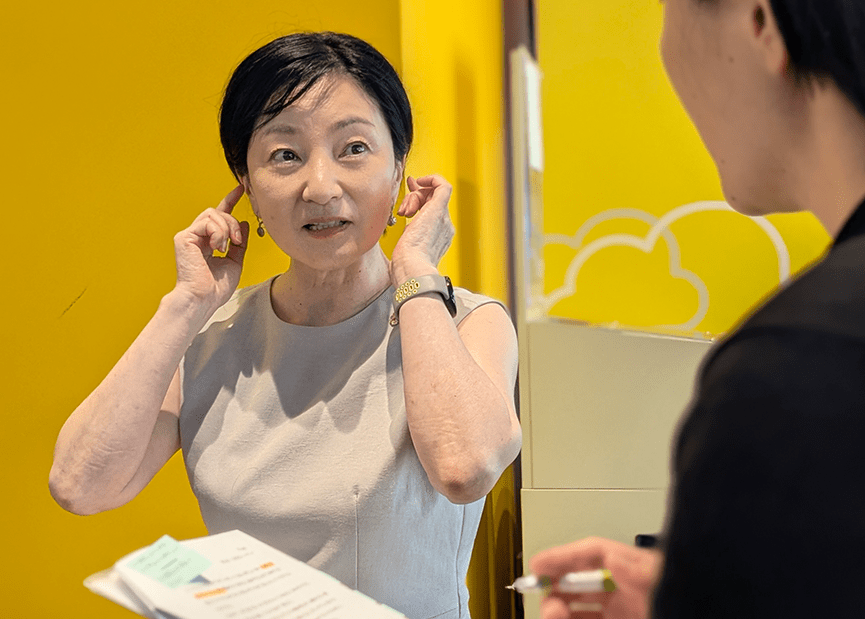
S: My daughter is three years old, and she can already listen with her whole body…!
N: The reason I focused on ears is because that is where it all begins. Children naturally adopt an attitude of “listening” rather than merely “hearing”, focusing not only their ears but also their eyes and hearts on the speaker. Observing babies, I am struck by how they seem to possess the capacity for active listening and empathy from birth.
S: Children and babies listen to our voices and notice every nuance.
N: The ear is such an important organ, yet it is always wide open. Though our ears are constantly exposed to stimuli, they receive far less care than our eyes or mouth. The ear is like skin. A gentle voice feels as pleasant as a soft caress, while loud shouting or high-pitched sounds feel like being beaten.
S: Being beaten… Does it feel like pain to children?
N: It is surprising, right? Most people have probably never thought about sound in this way.
If a stimulus is too strong, it becomes invasive and is perceived as pain. Children’s ears are far more sensitive than adults’, because their brains are still growing and they are learning how to use their senses. That is why hearing protection is necessary for all children.
S: I was aware of light stimuli, but I did not know about sound stimuli.
You are raising awareness of this issue through OmimimO.
🎧Let us build a culture everyone can wear!
From "Embarrassing" to "Cool!"
S: Earmuffs are often considered special equipment for people with auditory hypersensitivity.
N: Many people think that way, but in fact it is necessary for all children, whose brains are still developing. Children with sensitive ears can become completely exhausted in group settings, preventing them from performing to their full potential.
S: It is such a waste that earmuffs could make things easier…
N: Many children take their earmuffs off because they hate standing out, which is why I want to create a culture where everyone wears them.
S: That is a classic kid thing. They would probably say no to wearing it alone.
N: At stadiums overseas, it is perfectly normal for children to wear earmuffs. When I asked a professor in Germany about it, the professor looked puzzled and said, “Because everyone knows the loud noise at stadium is not good for children’s brain development”. I was startled.
S: If protecting children’s hearing becomes as common in Japan as it is in Europe, things might start to change.
N: If cool earmuffs became something that everyone naturally wore in Japan while cheering for their favorite team, children who need earmuffs in daily life might no longer feel embarrassed. I have always dreamed of being in a scene like this.
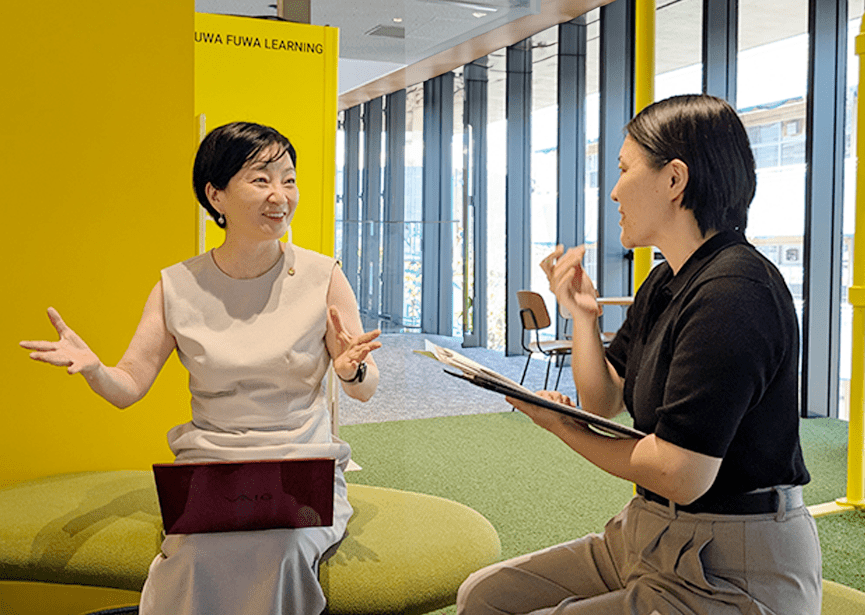
S: It is exciting to imagine the moment when the feeling of embarrassment turns into something joyful.
I would love to see everyone wearing earmuffs and cheering together!
N: Right! That excitement is important. Just by shifting from protective gear to cool fan merchandise, people’s perceptions change dramatically. When adults change their mindset, the environment for children to grow up in improves, and their quality of life changes.
🎧That is all for now.
In Part 2, we will explore the significance of parent-child time at stadium, the professor’s hopes for the future, and the story of collaboration that connects different fields.(👉Part 2)