
Even without blood, sweat, and tears, it is still beautiful.
Personally, I cannot imagine creating anything with my blood, sweat and tears. But, I could talk about crystallized plastics all day long because I am a specialist in the field. There are solid reasons why crystals form. The two key conditions are as follows:
1. Molecular structure is the determining factor.
Thermoplastic resins are materials that can be melted and solidified repeatedly. This is because long, thread-like molecules intertwine to form structures. The existence of the thread-like structure determines whether crystals can form. For example, we use different grades of polypropylene (PP) with varying degrees of crystallinity, such as high-crystalline and low-crystalline (amorphous) types, depending on the application.
- High crystallinity: Whitish color = low transparency
Low crystallinity: Highly transparent = aesthetically pleasing
In other words, the fewer crystals present, the clearer and more beautiful the appearance.
2. A trigger is needed to form crystals.
Even plastics with structures prone to crystallization become less likely to form crystals when cooled rapidly. This is because crystals are structures formed from folded-up molecules, so rapid cooling leaves insufficient time for folding. However, if you provide a trigger, such as a crystal nucleus, that makes it easier to form crystals, the process will be smooth. For example, the mineral-based additive talc is a prime example of a nucleating agent for PP. Crystals form more easily on the surface of the reinforced fibers, a phenomenon known as the effect of transcrystalline.
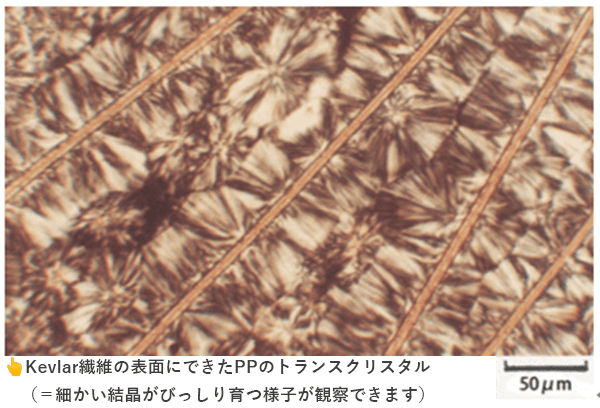
How can we make beautiful crystals?
No matter how many triggers you provide, a resin that is molecularly incapable of forming crystals cannot crystallize. By crystallizing, the following occurs:
Advantages: Chemical resistance improves, rigidity enhances
Disadvantages: Significant thermal shrinkage occurs, prone to uneven surfaces
So, different grades of PP are often used depending on the application:
Functional components
→Resin with high crystallinityComponents where appearance matters (such as decorative parts)
→Low crystallinity or no crystallinity (amorphous resin)
However, that does not mean resin with crystals cannot look nice. For example, when you mix a nucleating agent into a resin with a structure prone to crystallization and carefully cool it, very small crystals grow densely. When the crystal size becomes smaller than the wavelength of light (300 nm or less), it appears transparent. It creates crystals that look beautiful.
✅With care and effort, plastics can look beautiful.
Beautiful crystals can form with certain molecular structure and a little ingenuity.